
Mobile App Campaign Tracking: What Can (and Cannot) Be Measured Reliably
When running mobile app campaigns, teams often want a clear, end-to-end view of performance. Some parts of this funnel are easy and accurate to measure. Other parts are structurally difficult, expensive, or impossible to measure precisely due to platform privacy rules.
When running mobile app campaigns, teams often want a clear, end-to-end view of performance:
Ad → App Store → Install → Registration → Active User
Some parts of this funnel are easy and accurate to measure.
Other parts are structurally difficult, expensive, or impossible to measure precisely due to platform privacy rules.
This page explains what is realistically measurable today, and why certain gaps exist across the entire mobile industry.
Funnel overview
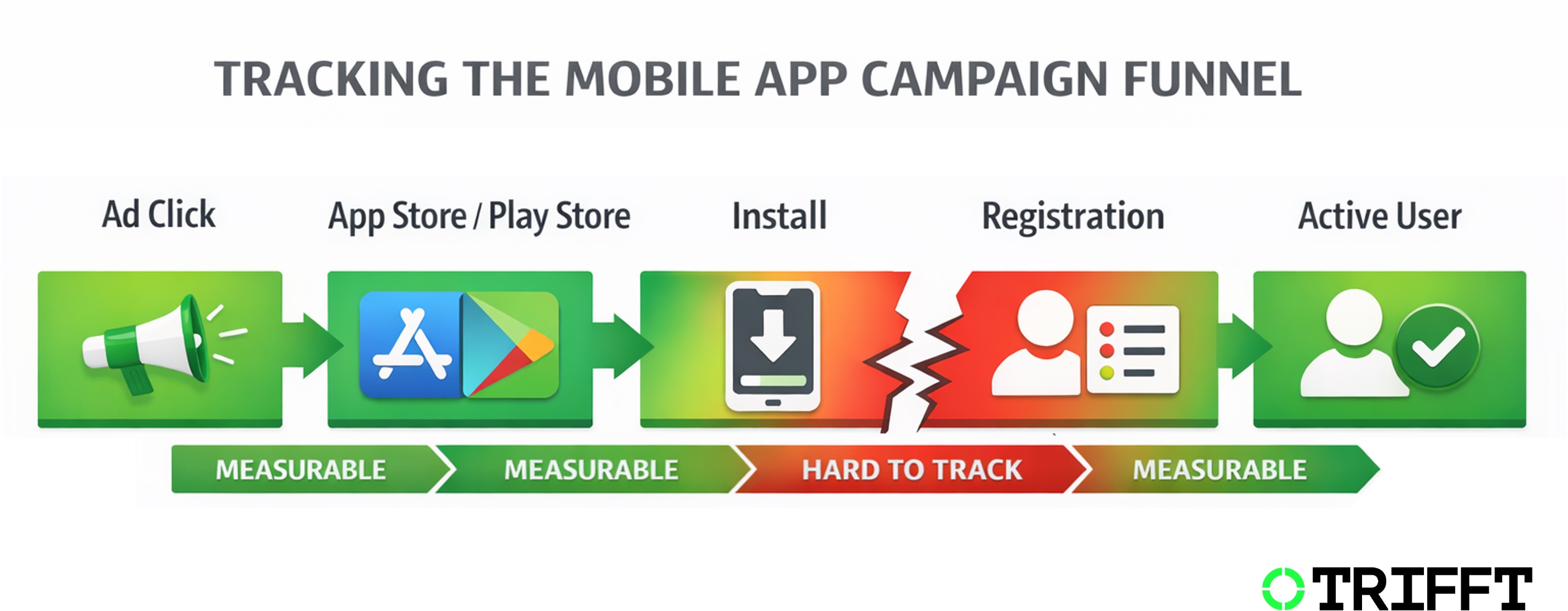
What is easy and accurate to track
1. Media performance (Ad → App Store)
The following metrics can be tracked accurately and consistently:
- Impressions
- Clicks
- Click-through rate (CTR)
- Cost per click (CPC)
- Traffic to App Store / Google Play
Why this works
This data comes directly from advertising platforms and does not rely on device-level user identification. Accuracy is high and consistent across channels.
2. In-app behavior after registration
Once a user installs the app and completes registration, it is possible to reliably track:
- Registrations
- Active users
- Engagement events
- Retention
- Transactions or other usage activity
Why this works
This is first-party, in-app data collected after the user has entered the app environment. It is fully under the control of the app owner and does not depend on ad attribution identifiers.
The hard part: App Store → Install → Registration
What is not reliably measurable for free:
- How many ad clickers actually install the app
- Which campaign led to a specific registered user
- Deterministic end-to-end attribution, especially on iOS
Why this is difficult
- App Store and Google Play do not pass a persistent user identifier into the installed app
- Ad click identifiers cannot be carried over after installation
- User-level linkage between ads and in-app users is intentionally restricted
This gap exists by design and affects all mobile apps and vendors equally.
The role of iOS “Do Not Track” (ATT)
On iOS, users can opt out of tracking via App Tracking Transparency (ATT).
When a user chooses “Ask App Not to Track”:
- Device-level identifiers (such as IDFA) are unavailable
- User-level attribution is blocked
- Ad click → install → user linkage cannot be established
What remains possible:
- Aggregated, privacy-safe reporting
- Modeled or estimated conversions
- Directional trends rather than exact user-level attribution
There is no compliant technical workaround for this limitation.
Why some companies use paid attribution tools
Large advertisers sometimes use third-party mobile attribution platforms such as:
- AppsFlyer
https://www.appsflyer.com/ - Adjust
https://www.adjust.com/ - Branch
https://branch.io/
These tools:
- Do not bypass platform privacy rules
- Use Apple- and Google-approved attribution frameworks
- Apply statistical and probabilistic modeling
- Improve directional campaign comparison at scale
They typically make sense when:
- Monthly media spend is in the range of €100,000+
- The goal is relative campaign optimisation rather than exact user-level truth
For smaller spends, the cost and complexity often outweigh the benefits.
Summary
- There is no free, precise, end-to-end mobile attribution solution, especially on iOS
- This limitation is industry-wide and platform-driven
- A practical measurement approach combines:
- Accurate media performance metrics at the top of the funnel
- Reliable first-party data after registration
- Directional (not exact) interpretation of end-to-end ROI
This reflects the current, accepted state of mobile measurement across the industry.